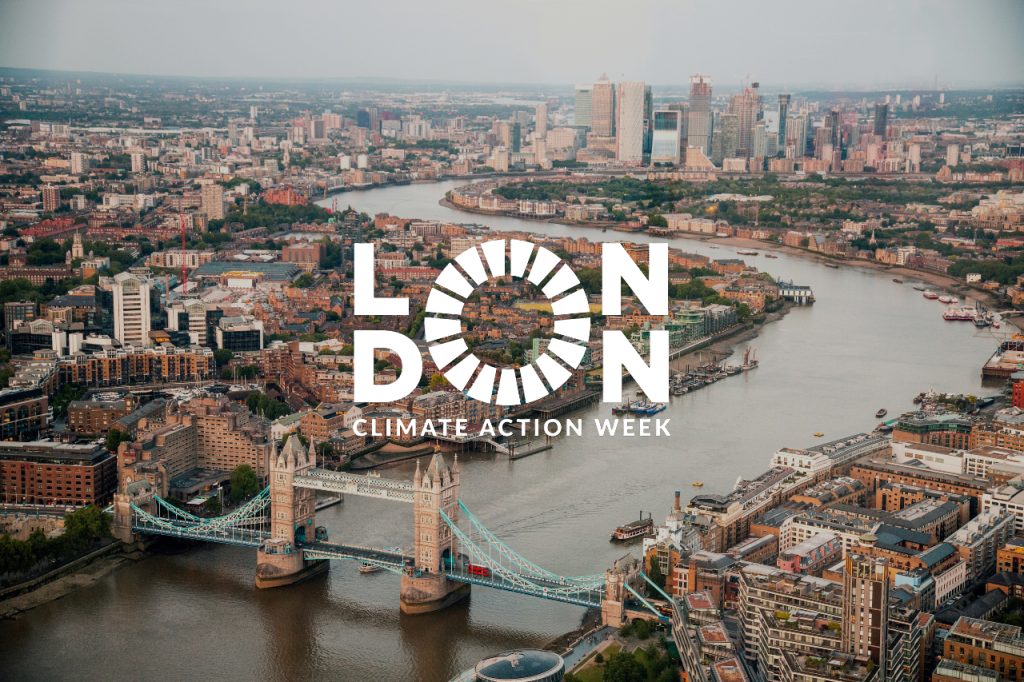
London Climate Action Week (LCAW) is back this June, and it’s going to be bigger, busier and more politically significant than ever.
Running from 20–28 June 2026, the week is now widely recognised as Europe’s largest city-wide climate festival, bringing together tens of thousands of policymakers, businesses, investors, NGOs and campaigners across hundreds of events.
But LCAW isn’t just another moment in the sustainability calendar. It has become a key staging point in the global climate conversation where ideas are tested, alliances are formed, and increasingly, where action is expected.
So what makes London Climate Action Week 2026 worth paying attention to? And what should organisations be watching closely this year?
1. It’s a bellwether for global climate momentum
LCAW has evolved into a pivotal moment between COP cycles as a space to take stock of progress and signal priorities ahead of the next round of global climate negotiations.
With policymakers, investors and corporates converging in one place, the week offers a real-time readout of where climate ambition is both heading and where it’s stalling.
What to watch:
- Signals on priorities ahead of COP31
- New policy direction across both the UK and internationally
- Where business and finance are recalibrating strategies
2. From commitments to implementation
A consistent theme emerging around LCAW is a shift away from announcements towards delivery.
In 2026, the focus is firmly on “implementing, not just declaring” climate solutions, with attention on what’s actually being delivered on the ground. This reflects a broader shift across sustainability communications: stakeholders are increasingly sceptical of pledges without proof.
What to watch:
- Practical case studies and delivery models
- Evidence of real-world impact, not just targets
- Scrutiny on corporate claims and accountability
3. Climate finance moves centre stage
If there’s one theme that continues to dominate, it’s finance.
LCAW brings together the institutions shaping capital flows – from asset managers to multilateral banks – making it a key forum for debating how climate action will actually be funded.
Expect continued focus on closing investment gaps and mobilising private finance, particularly in emerging markets.
What to watch:
- New financing mechanisms for adaptation and resilience
- Debate on investment gaps and risk pricing
- The role of private capital in delivering net zero
4. The rise of adaptation and resilience
As the physical impacts of climate change intensify, adaptation is moving from a secondary issue to a core strategic priority.
Discussions at LCAW 2026 are expected to reflect this shift, with resilience, infrastructure and climate risk management climbing the agenda.
This marks an important narrative change: climate action is no longer just about mitigation, but about managing unavoidable impacts.
What to watch:
- Investment in climate resilience, including water, infrastructure and cities
- How adaptation is framed as economic opportunity
- Integration of climate risk into business decision-making
5. Nature and climate are converging
There is growing recognition that climate and nature are inseparable challenges.
Recent LCAW discussions have highlighted how biodiversity loss and climate risk are deeply intertwined, with growing momentum behind nature-based solutions and nature finance.
What to watch:
- Nature-positive strategies entering the mainstream
- Corporate positioning on biodiversity
- Growth of nature-related finance and disclosure
6. A true “whole-of-society” moment
One of LCAW’s defining strengths is its breadth.
Unlike traditional conferences, it is a city-wide platform spanning policy, business, culture and community engagement, bringing together actors that don’t usually share the same space.
This makes it a powerful moment for both cross-sector collaboration and for reframing climate action beyond the usual audiences.
What to watch:
- Unlikely partnerships across sectors
- Greater inclusion of community voices
- Cultural and creative approaches to climate storytelling
7. London’s role as a global climate hub
LCAW also reinforces London’s position as a global centre for climate leadership.
The city’s unique concentration of financial, political, cultural and professional institutions makes it both a natural convenor and a testing ground for ideas that can scale globally.
In a more fragmented geopolitical landscape, this role is becoming increasingly important.
What to watch:
- London-led initiatives with global reach
- How UK leadership on climate is positioned internationally
- Collaboration across the “London climate cluster”
8. A moment that shapes narratives as much as policy
For communications teams, LCAW is as much about narrative as it is about policy. It’s where:
- New storylines emerge
- Language around climate action evolves
- Organisations position themselves publicly on key issues
- Reputations are either made or challenged.
What to watch:
- Dominant media narratives emerging from the week
- How organisations communicate progress vs ambition
- Opportunities for thought leadership and rapid response
Why it matters for organisations
London Climate Action Week is no longer just an “industry event”. It is a strategic moment to engage, influence, be seen and accelerate action– whether that’s through events, partnerships, media or thought leadership.
For organisations working in sustainability, policy, finance or beyond, the question is no longer whether to engage but how to do it meaningfully and credibly.
London Climate Action Week 2026 won’t just reflect where climate action is today – it will help define where it goes next.
If you’re looking to make the most of your involvement in LCAW, please reach out to us: info@forster.co.uk
Get 3 sustainability comms takeaways
Learn what worked, what made the difference, and what you could apply from three effective sustainability and social impact campaigns.