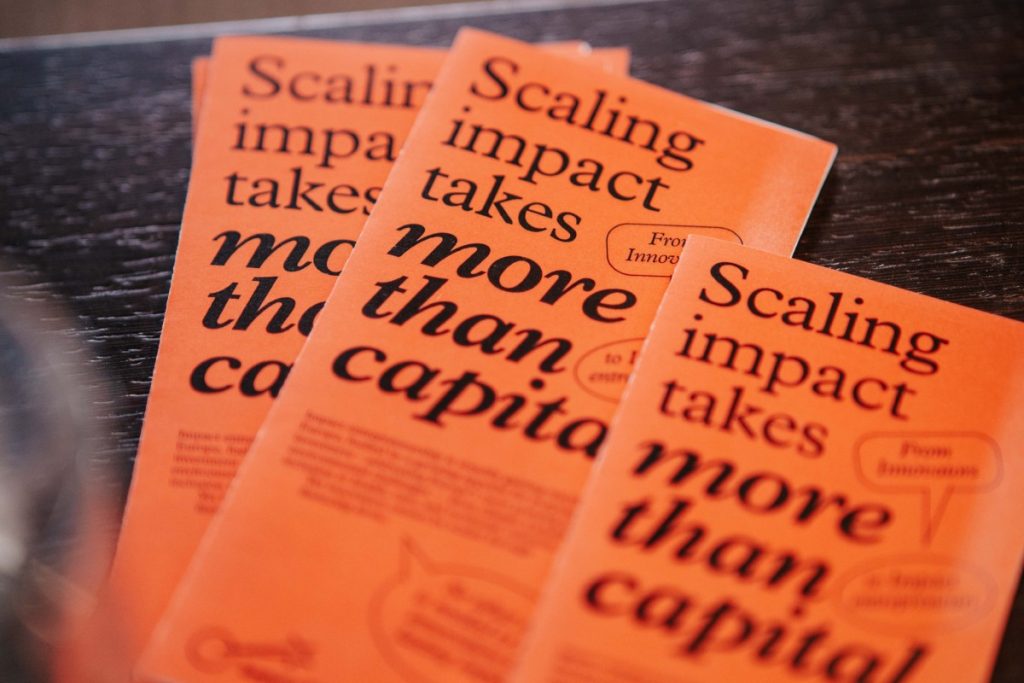
At Impact Europe’s Impact Days in Brussels this month, conversations focused on how we can move more capital towards impact. It was energising to hear from organisations in the public, private and philanthropic spheres, all deeply invested in making change happen.
There’s clearly momentum. We heard about initiatives like the EU’s Global Gateway, designed to strengthen critical infrastructure and services from energy to health, while helping to close the global investment gap in line with the SDGs and Paris Agreement. Alongside this, there is a growing appetite from foundations to step in and absorb concessionary losses to unlock more private investment. The building blocks for systems change are starting to align.
But one question remained.
How do we reconcile impact investing within a capitalist system? And, more to the point, can we?
There isn’t a simple answer. But what I heard over the two days suggests the tension may be less about whether it’s possible and more about how we understand value, risk and return within the system we already have.
In these settings, communications can at times feel peripheral, particularly when conversations turn to debt structures, blended finance or policy reform. But the more I listened, the more it felt like communications sits closer to the heart of this challenge than we might think.
Because if we have any hope of resolving that bigger tension, we need a much broader public understanding of how the current system is working against us.
The examples are already there. Pension systems that prioritise returns in ways that ultimately undermine long-term wellbeing. Insurance models that continue to fund response rather than prevention, effectively paying again and again for crises they could help mitigate. There’s a deep irony in the system that is not widely understood.
Until it is, it’s difficult to see how we get the kind of informed public pressure that can shift regulation at scale.
That same gap shows up in conversations about institutional investors. There’s still a persistent perception that investing for impact comes at the cost of returns and therefore needs to be offset elsewhere. But that logic rests on a narrow view of value.
It overlooks the fact that impact-led businesses can deliver both financial and social returns. And it ignores the contradiction that many so-called “high return” investments (such as the exploration, extraction and refining of fossil fuels) are actively driving the risks and costs that impact investments are trying to address.
In other words, the system isn’t just flawed and working against society. It’s working against itself.
What struck me too is how much of this is shaped by perception rather than reality. Several discussions touched on the gap between perceived and actual risk in impact investing. Where understanding is low, perceived risk rises and with it, expectations on returns. The result is a higher barrier to entry for the very projects designed to deliver long-term value.
The same misalignment is playing out in public-private partnerships. Even with early risk mitigated through blended finance structures, there’s still hesitation. Some investors are looking for market-rate returns, others for outsized impact and there’s often confusion about where the line sits between investment and philanthropy.
Again, this feels like a communications challenge as much as a financial one.
There’s a clear role for better storytelling, not just within the impact “echo chamber”, but with audiences who haven’t yet been brought into the conversation. We need to show where these models are working, what risk actually looks like in practice, and how value is really being created.
There’s also a more practical opportunity. Many partnerships don’t fully account for, or openly discuss, the time and resource required to get off the ground. Identifying the right partners, aligning incentives, navigating legal structures and dedicating internal teams all come with significant cost. Too often, substantial upfront investment only unlocks relatively small amounts of capital for impact projects, which makes scale critical, whether that’s growing the size of individual partnerships or making models easier to replicate.
This calls for greater transparency. Stronger feedback loops, and more consistent sharing of lessons learned, could help the wider ecosystem avoid repeating the same inefficiencies.
And underpinning all of this is something more fundamental: a shared language.
If different parts of the system are talking past each other, using different definitions of risk, value or impact, it’s no surprise that progress feels slow. Communications can help bridge that gap, shaping a clearer, more consistent way of talking about what this market is trying to do.
Done well, communications has a role to play in shifting how value, risk and return are understood, and in doing so, helping the system work better for people and planet.