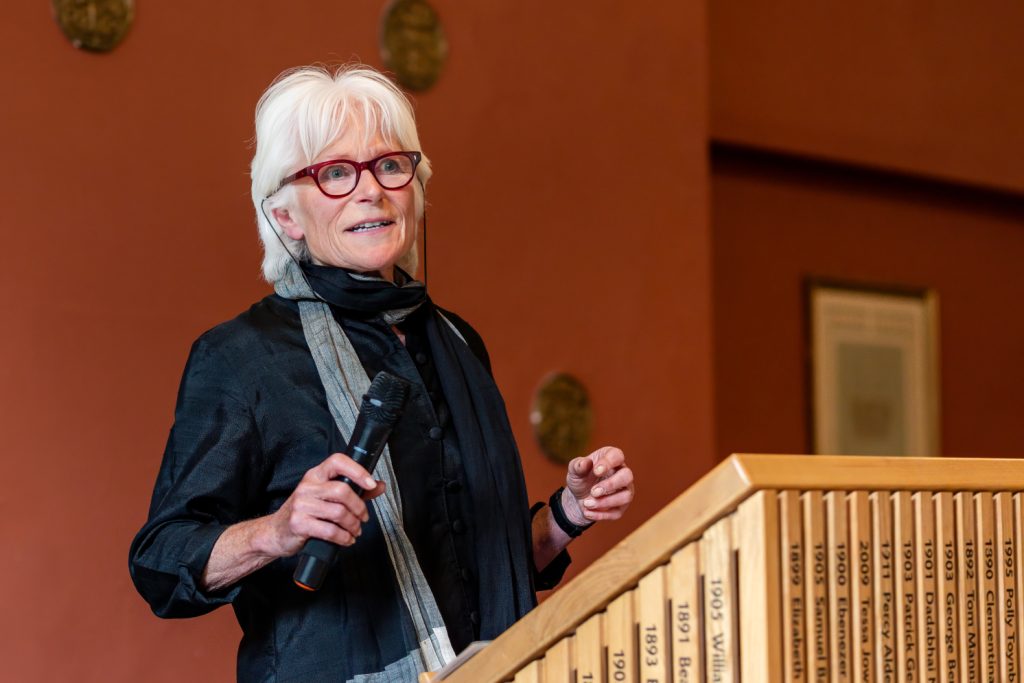
At her keynote speech for Forster’s 30th anniversary celebration, Founder Jilly Forster bought past experiences to the present day and explored what it means to grow, adapt and stay relevant in a rapidly changing world.
Drawing on her personal journey – from prawn fishing to The Body Shop to business founder – she challenged the audience to consider whether they are simply ageing or actively evolving. She reiterated her belief that business can be a force for good, and that integrity, collaboration, curiosity and adaptation are essential ingredients for sustained positive impact.
Finishing with a reiteration of Forster’s role, Jilly called on everyone to have the confidence to lead, to remain purposeful and positive and remember that there is no set recipe. Here’s to the next 30 years.
Because hard is not the same as hopeless. It is the people, businesses, non-profits, networks and communities who know this that’ll be the ones to make positive change happen.
The speech given by Jilly Forster at Forster’s 30th celebrations, May 2026
It’s taken Forster 30 years to look like this. It’s taken me over 70. And it’s taken The Body Shop 50, The Big Issue 35 and The Forgiveness Project 25.
Although this moment isn’t about celebrating age, it does provide a pause for reflection and an opportunity to check in on whether we feel we’re ageing well. Are we wearing out – or evolving and growing? Are we still relevant?
I’m no longer formally involved with Forster, but of course the past informs us, so a little about me.
Didn’t go to university, first job crewing on a prawn fishing boat off the west coast of Scotland. Loved being in ‘big nature’, having the opportunity of ‘rewilding my mind’, loved the hard, physical work and loved the sense of close community in that part of the world. But needed to get permanent job.
So I lied about my age, embellished my CV, and ended up in the press office of a large record company, working with names such as The Stylistics, Thin Lizzy, and Status Quo. This was my first experience of working in a business – the record industry was booming back in the 70s. I got my NUJ card and was part of a group writing a weekly reggae column for Sounds under the pseudonym of Flip Fraser.
All of this might have seemed glamorous. It wasn’t. But goodness I learnt a lot, including the realities of working for a solely profit-driven business (where I witnessed bribery, ruthlessness, a lack of care for anyone who wasn’t a ‘star’, misogyny, and so on).
During my time there, I remember helping to launch 10cc’s Life Is A Minestrone single – that was in 1975. Pretty bonkers song, but its title struck me as relevant for what I want to say this evening.
Literally translated, minestrone means a ‘big’ soup. There’s no set recipe, it’s down to you, the cook, to use what’s to hand. It’s all about combining leftovers or odd ingredients to create a unified, nourishing result.
I like this approach to cooking – of creating things – particularly as I’m not very good at following rules or being constrained by process and regulations. And en route I’ve learnt there are a few essential ingredients that can make this big soup even more delicious and relevant:
- Whatever you do, cook up something that is for mutual benefit.
- Approach life with a generosity of spirit – without expecting anything in return.
- Don’t just stick with your knitting – keep your eyes wide open, constantly adapt and try new ways of doing things.
I set up a PR agency, Munro & Forster, in the early-Eighties. One of our first clients was The Body Shop; they were then 7 years old and going to market (ie being listed on Stock Exchange) and growing like topsy. I had an immediate bonding with the Roddicks and their business ethos just made sense to me. I wasn’t actually that interested in skin and hair care but was very interested in the notion that if you want to change the world, you can do it through your business model – and if you want to change your business, then engage in changing the world!
Business can be part of the solution. You can take your heart to work with you and help drive progress, innovate, make a positive impact. It’s more than okay to combine profits with kindness, activism and social responsibility.
You here know all this. Anyway, I joined their board 4 years later. Then 30 years ago I left.
The Body Shop had grown up and I didn’t believe it was ageing well. It had lost its sense of bravery/daring-do/mischief-making and had stopped innovating. I was spending more and more time in the business of the business, guided by lawyers and accountants. In amongst lots of internal politicking, management consultants were brought in and they tried to codify everything – including creativity and values – things you can’t just put in a box and are part of the DNA of an organisation; they can’t be confined to the responsibility of just one person, department or function.
But what I did take away from the early days at The Body Shop was that:
- We’re in this together and a community of people, bound by shared vision, can achieve remarkable things.
- In times of adversity, stick with your values and stay the course with integrity, without compromising your behaviour. When things are tough, never stop being honest, open and transparent in everything you do.
- Don’t underestimate the power of integrated, collaborative comms; start from the inside and work out – making friends and strategic alliances as you go.
- Wherever possible, make the complex accessible. Package, translate and communicate a genuine ‘cause’ in a way where everyone can engage / become involved with/empowered by. The think-act-change protocol!
- And, however big you get, never under-estimate the power of one. I still like that quote: ‘if you think you’re too small to make a difference, try going to bed with a mosquito’.
- But, reality check. Underscoring all of this, there’s the imperative of meeting genuine market needs. If no one wants what you’re offering, you’ll have no business.
I took these learnings when set-up Forster.
Remember the context: 1996. Google was born (as ‘Backrub’). To most people terrorism meant the IRA and climate change was a specialist interest issue. Airline passengers could still smoke cigarettes on flights. Melissa virus, Millennium Dome, Blair election campaign were all being worked on. And the responsible business movement was still ‘business as UNUSUAL’.
If Body Shop was about trading for change, Forster was about using the power of communications for change – working with clients and changemakers from all sectors to help protect and improve lives.
People here know some, if not all, parts of Forster’s journey thus far. It’s been far from plain sailing. We’ve had some significant successes and a few flops, including developing new practice areas to offer services that we thought were brave, bold and relevant but that people weren’t interested in buying!
That was then. Inevitably people, services, areas of expertise and clients have – and will – change and evolve. From what I can see, the core belief system and purpose remain the same and the imperative of keeping the human touch in everything Forster does is very apparent.
Will Forster still matter in the future? Of course it will. Any of the big issues and challenges we face today – locally, nationally, globally – are problems we’ll have to navigate across generations, and real change doesn’t come through quick fixes. So keep slogging, keep pushing boundaries, keep growing your group of collaborators, keep focusing on the long-term.
I just wanted to emphasise a couple of things I hope are relevant.
1. An attitude: think positive
How do we respond to tough conditions, when it’s deemed that ‘everything is terrible’? A recent research project found that, with each additional negative word, click-through rates increased, while positive language reduced engagement. Alarm travels fast. Anxiety performs. Bleakness is often not just a reaction to events – it’s becoming a business model.
When circumstances are genuinely bad, things don’t get better from pretending everything is fine. Survival comes from noticing what still works, what your non-negotiables are, and building from there. Because hard is not the same as hopeless. It is the people, businesses, non-profits, networks and communities who know this that’ll be the ones to make positive change happen.
So, to maintain the ability to stay capable when conditions turn against you: think positively. The behavioural truth matters most: people who genuinely think improvement is possible plan further ahead, persist longer and stay in the arena. Confidence breeds action. Action breeds confidence.
2. Outriding with purpose
Of course, change is going to happen. But inflection points – whether personal or global – aren’t just moments of change; they offer great opportunities for growth and adaptation, of ‘reassessing all you have been told’ (quote from Walt Whitman’s poem Leaves of Grass).
Inflection points are notoriously difficult to spot – and are usually identified in hindsight. Spotting them requires serious Outriding, by which I mean watching out for signals. They maybe whispers of new tech, changes in laws/regulation, shifts in customer behaviour, polls and research, culture and the arts, what’s happening on the street, new products/services…
Reading these signals, keeping ahead of the curve, having the ability to see round corners is critical. But it’s no good just spotting them if you’re reluctant, or unable, to act. So, please, continue to push the value of your real ability to help people – from employees to clients – deal with change.
So, yes, Life Is A Minestrone. There is no set recipe, and it makes a good analogy for the idea that ‘the whole can be richer, greater, than the sum of the parts’.
Forster – and all who are here – have confidence to lead not follow and remain purposeful and positive; disarmingly honest and hugely capable; collaborative, curious and creative.
Here’s to the next 30.
_______________
Photo by Sarah Tulej