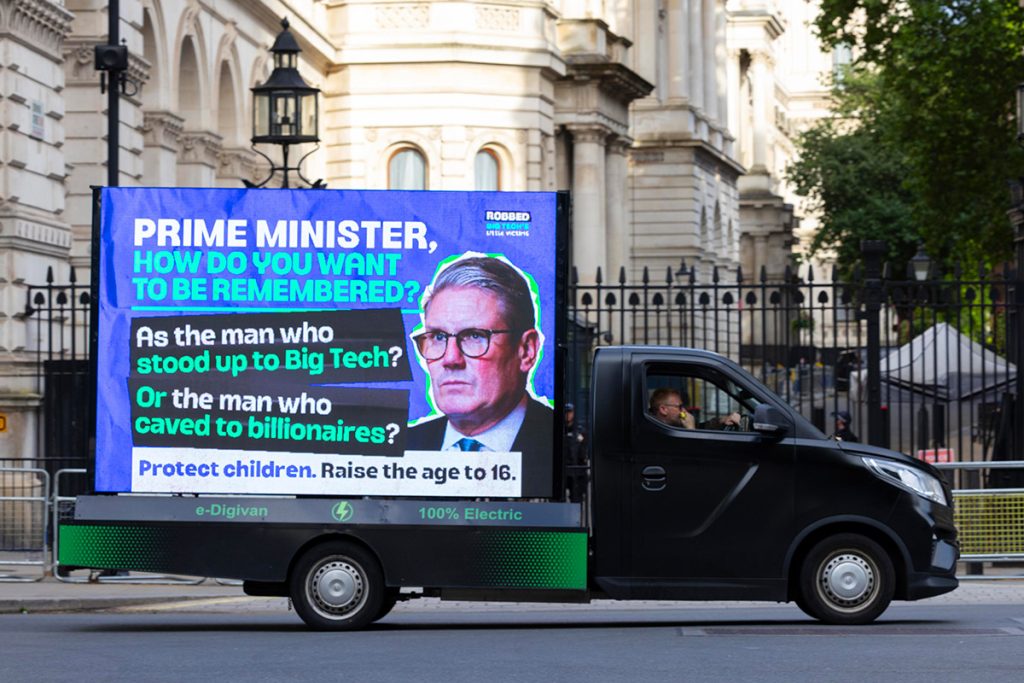
With the Government now committed to raising the age of social media access to 16, Forster and Inflect reflect on what their work on the National Education Union’s (NEU) Big Tech’s Little Victims campaign taught them about turning public pressure into political action – and why the work is far from over.
Policy change rarely happens because of one headline, one report or one meeting with a minister. The best campaigns build a case from every angle until political action becomes harder to avoid than to deliver. Decision-makers need to hear the same argument from every direction: in the media, from stakeholders, through public opinion and inside Westminster.
That takes more than a good story. Some campaigns generate headlines but never translate attention into political momentum. Others focus on public affairs but fail to build wider support. In reality, a campaign may only get a handful of chances to reach the person with the power to act. Everything else has to build the case before, during and after those moments.
For Big Tech’s Little Victims, we treated media, public affairs, stakeholder engagement and social content as one connected campaign – making sure every channel, message and moment was working towards the same outcome. Looking back, five lessons stand out for organisations trying to turn public concern into political action.
START WITH A CLEAR POLICY GOAL
The strongest policy campaigns start with a specific ask. It can be ambitious, but it must be concrete enough for journalists to explain, supporters to repeat, and policymakers to respond to. Vague calls for “more action” are easy to agree with but are also easy to ignore.
The strength of Big Tech’s Little Victims lay in the simplicity of its central ask: raise the age of social media access from 13 to 16. That clarity allowed different audiences to engage with the issue while still pointing towards the same outcome.
BUILD ONE CAMPAIGN, NOT TWO WORKSTREAMS
Too often, PR and public affairs operate separately, with different strategies, timelines and definitions of success. Media coverage can create political space for action, while political insight can sharpen the message, timing and target of communications. When those disciplines are joined up from day one, each makes the other much more effective.
For Big Tech’s Little Victims, that meant Forster and Inflect operating as a single campaign team, rather than running parallel workstreams. Every part of the campaign was designed to support the others. Whether it landed on breakfast TV, appeared in social content, came up in stakeholder conversations, or was taken into meetings with MPs, the same evidence, messages, and campaign objectives reinforced one another. That integration meant activity in one channel strengthened activity in another, building momentum across media, political and public audiences around a single ask: raising the age of social media access from 13 to 16.
REFRAME THE DEBATE IF YOU NEED TO
Policy change often depends on changing how people understand a problem. In the case of children and social media, the debate had become focused on phones, screen time and parental responsibility. Of course, those issues matter, but they did not fully reflect the harm teachers and parents were seeing every day.
So, we reframed the debate. Instead of adding to the conversation on screens, Big Tech’s Little Victims put platform accountability and algorithmic harm at the centre. The campaign made a clear argument: children were not simply spending too much time online; they were being exposed to systems designed to maximise attention and profit. That made the issue more urgent, more credible and harder to dismiss as a private problem rather than a systemic one.
BUILD EVIDENCE AND EMOTION
For Big Tech’s Little Victims, we built the case using research, polling, support from political and other influential voices, and testimony from teachers and parents witnessing the impact on children every day. Data alone rarely changes policy, while personal stories can struggle to command attention without supporting evidence. Together, they made the argument human enough to move people and robust enough to withstand scrutiny.
CREATE MOMENTS POLICYMAKERS CANNOT IGNORE
The issue with algorithmic harm is that it wasn’t easy to explain or evidence. We needed to turn it from an abstract concern into something policymakers could not look away from. To do that, we created The Algorithm Experiment, a simple evidence-gathering project in which we set up fictional profiles of 13-year-olds on social media to examine what content major platforms would serve to children at their stated minimum age of access. It turned an invisible harm into something immediate, visual and difficult to dismiss. It gave journalists a tangible story, helped social audiences understand the issue and provided MPs with evidence they could engage with directly.
This is where media momentum becomes politically useful. Policymakers are influenced by what dominates the news agenda, what constituents are seeing, and what colleagues are discussing in Parliament. A powerful campaign moment can help create the pressure and political permission needed to act.
We did not treat our media moment as the win. Seeing Good Morning Britain make the Algorithm Experiment its top story was exciting and validating, but its real value was what it unlocked next: taking the experiment’s results and media coverage into Parliament to strengthen the political side of the campaign.
PLAY THE LONG GAME
We knew the campaign could not rely on a single peak of attention. Meaningful policy change rarely happens overnight, so we kept the pressure up between the bigger moments: through reactive media, thought leadership, stakeholder engagement and political follow-up that kept the issue in front of decision-makers when the news agenda moved on.
Even now, the policy announcement is not the finish line. The Government’s commitment to raise the age of social media access is a major milestone, but the next phase will be implementation: influencing the details, maintaining support, and ensuring the promised change is delivered in practice.
TURNING ATTENTION INTO ACTION
Big Tech’s Little Victims shows that campaigns don’t change policy by making noise alone. They do so when media pressure, public concern, credible evidence and political engagement are deliberately organised around a clear ask.
That is how you move an issue from the margins to the mainstream, and from the mainstream into Westminster. The challenge is not just getting people to care. It is creating the evidence and pressure decision-makers need to act.
If you want support with policy campaigning or turning public momentum into action, contact Sophie Kinsella at sophie@forster.co.uk to discuss how Forster and Inflect can support.